|

 |
|
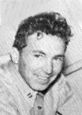
LtCdr. Patrick D. Fleming * 1918 - 1956
squadron: VF-80 (Vorse's Vipers)
Ship: USS Ticonderoga, Hancock
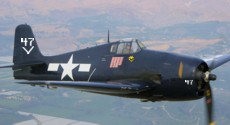
Kills: 19 Plane: F6F
Medals: Navy Cross, Silver Star (3)
Distinguished Flying Cross (3)
Air Medal (4) |
========================== |
| | |
 |
| |
Fleming was an "Army brat" and an Annapolis graduate, the only ace from the class of 1941. He did a surface tour in cruisers, then applied for flight training. He won his wings in 1943 and was promptly assigned to be an instructor. He joined VF-80 in March, 1944.
His brief fighter career demonstrated the dominance of the U.S. Navy's carriers and Hellcats in the later stages of the Pacific War. Fleming engaged only nineteen targets during six combat missions between Nov. 5, 1944 and Feb. 17, 1945; he shot down all nineteen. His first kill was a Zero, over Manila, his only single victory.
After the war, he served at the Navy's famous Pax River test center, where he lived near Marion Carl's family. In January, 1947, General Curtis LeMay invited him to transfer to the new USAF Strategic Air Command (SAC) as a Lt. Col. He died in 1956 when he bailed out of a B-52, but his chute caught fire.
* * * * * * * * * * * * * * * * * * * * * *
Navy History
Fleming's carrier, Ticonderoga (CV-14), gave aerial support to the Mindoro landings in the Philippines in mid-December 1944. At dawn on Dec. 14, the Hellcats started things with a series of fighter sweeps. VF-80 was one of the few squadrons to find combat when its fliers caught 27 Zeros trying to reinforce Mindoro. "Vorse's Vipers" shot down nineteen of them, four by Pat Fleming. On Jan. 3, 1945, the fast carriers went after Formosa, but bad weather prevented most squadrons from getting through. VF-80 did get to its objective and swept the area looking for targets; "P.D." Fleming found and shot down three.
As the kamikaze threat grew, the Navy increased the number of fighters on the carriers. When the VF squadrons exceeded 70 planes, they became increasingly awkward to administer, and many squadrons split into more manageable VF and VBF (fighter-bomber) squadrons. Frequently the two squadrons ran the same type of missions and both usually flew Hellcats. So it was with VF-80; on Jan. 10, 1945, VBF-80 was established, with Pat Fleming as its exec. While the distinctions between the two squadrons were mainly administrative, the records show that Fleming scored ten with VF-80 and nine more with VBF-80.
The carriers struck at Formosa again on the 21st, fiercely engaged by kamikazes. Three groups came at Ticonderoga, one hitting it with a 550-lb. bomb. As fires raged from this hit, another one crashed into the carrier's island, bringing the fatalities to 143. Several VF-80 pilots, including Pat Fleming manned the AA guns after the first attack. When the second Zero hit, a piece of falling debris hit Fleming on the helmet and knocked him overboard. A nearby destroyer rescued him. Due to the extensive damage to Ticonderoga, the air group transferred to Hancock (CV-19)
In mid-February, the carriers hit the Home Islands themselves, for the first time since the Doolittle raid of April, 1942. Fleming led nine VBF-80 Grummans on a Feb. 16 fighter-bomber attack on the Mobara airfield; they successfully bombed three of its five hangars. He spotted three Zeros high above and zoomed up to engage them. Approaching from behind, he burned two immediately, then chased and exploded another pair. He also hit another from behind (for a confirmed or probable kill, depending on the source). Fleming's Navy Cross citation for the mission credited him with five kills. The next day, Feb. 17, he closed his score with four more victories over Japan. VBF-80 went home in March, 1945.
* * * * * * * * * * * * * * * * * * * * * *
Air Force History
After World War II, Fleming resigned his commision in the navy and tranferred to the Air Force. Prompted by an invitation from General Curtis LeMay, Fleming became a Lt. Col. as part of the new USAF Strategic Air Command and participated in several projects as a test pilot. During the Korean Conflict, Fleming commanded a bombing group
One of the problems experienced by all early jet fighters was their relatively limited range and endurance as compared to conventional piston-engine fighters. One idea that was given serious thought at the time was for jet fighters to be towed like gliders behind bombers until they reached the combat zone. These fighters would then be cut free, start their engines, and engage in combat. When combat was over, the fighters would re-link to the bombers for the tow back home.
P-80A serial number 44-84995 was transferred to Wright Field for use in testing of the feasibility of this idea. An attachment bar for the cable tow was installed in the nose of the P-80A. It could be engaged or released by the pilot. The cable not only provided a tow, it also provided electrical power to the P-80A. Several tests were carried out in which the aircraft was towed behind a Boeing B-29A-10-BN (42-93921).
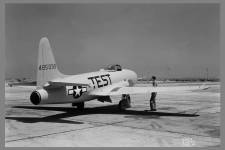
On September 23, 1947, Lt. Col Pat Fleming took off and attempted to link up in midair to the B-29 tow cable. After several attempts were frustrated by air turbulence from the B-29, he finally succeeded in linking up to the end of the tow cable. He was towed through the air for 10 minutes. When it came time to unhook, the tow bar stubbornly refused to release. Fleming finally maneuvered underneath the B-29, where the bomber's bow wave snapped the attachment point backwards, blocking his forward view. Fleming managed to land safely, but the program was immediately terminated as being impractical. 44-84995 was eventually repaired and restored to standard P-80A configuration and returned to active service.
** * * * * * * * * * * * * * * * * * * * *
X1 rocket program
Colonel Fleming (USAF) was one of the test pilots of the first of the rocket-powered research aircraft. The X-1 (originally designated the XS-1), was a bullet-shaped airplane that was built by the Bell Aircraft Company for the US Air Force and the NACA. The mission of the X-1 was to investigate the transonic speed range (speeds from just below to just above the speed of sound) and, if possible, to break the "sound barrier."
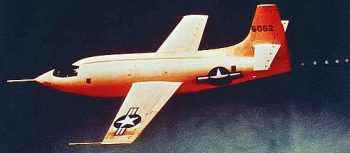
The X-1 would go on to achieve a maximum speed of Mach 1.45 or 957mph on March 26th 1948 in the hands of Chuck Yeager .
Colonel Fleming (USAF) flew in the X1 on October 6th 1949. The X1 was the first in a line of X- aircraft leading to the space shuttle of today.
* * * * * * * * * * * * * * * * * * * * **
Project 52 AFR-18
Project 52 AFR-18, originally envisioned using two modified B-47Bs from the 306th Bomb Wing, MacDill AFB, Fla., to make deep penetrations over Siberia via widely different routes. Two top crews were selected for the mission and were briefed by LeMay personally. The primary crew was led by Col. Donald E. Hillman, deputy commander of the 306th, with Maj. Lester E. Gunter as copilot and Maj. Edward A. Timmins as navigator.
The backup crew was led by Col. Patrick D. Fleming. His crew consisted of Maj. Lloyd F. Fields as copilot and William J. Reilly as navigator. The approved route took the B-47s from Eielson AFB, Alaska, north to a refueling point near Point Barrow, then west past Wrangel Island to a point near Ambarchik. It then turned southeast, to parallel the length of the Chukotskiy peninsula to Provideniya, thence east to return to Eielson.
The two B-47s took off on Oct. 15, 1952, following the two KC-97 tankers assigned to them for support. After refueling, Fleming flew to an area over the Chukchi Sea, taking up a racetrack pattern.
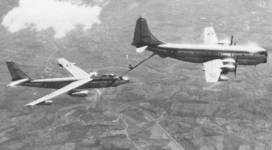
The mission proceeded as briefed, with Hillman flying at 40,000 feet at 480 knots true airspeed, presenting a difficult target to intercept. The Soviet air force, however, was ready, and after two targets had been photographed, the Americans became aware that they were being tracked by MiGs. Hillman broke radio silence to alert Fleming of the possibility of an attack. Gunter turned his seat 180 degrees to prepare his rear turret for firing, but the MiGs were unable to get into position and the rest of the mission went off without incident.
The flight lasted nearly eight hours and covered roughly 3,500 miles, 800 of them in Soviet territory. The photographs revealed that the Soviet air force was not massing their Tu-4s for an attack.
Project 52 AFR-18 was embraced by newly inaugurated President Eisenhower, who was so deeply convinced of the need for reconnaissance some said he had a "Pearl Harbor complex." In any event, he took great political risks to back long-range reconnaissance, including the development of specialized aircraft for the role. Eisenhower was quite good at photo interpretation and often would inspect intelligence photos himself, magnifying glass in hand.
Distingushed Flying Cross
Six months later, in April 1953, Colonel Hillman was reassigned to SAC headquarters and ordered to report to General LeMay's office. When he entered, General LeMay stood up and closed the door. Without saying a word, he pinned a Distinguished Flying Cross (DFC) on Hillman's blouse. When he saw the puzzled look on Hillman's face, LeMay gave him a slight and rare smile. "It's secret," he said. The two other members of Hillman's crew, as well as Colonel Fleming and his crew, also received DFCs. The award citations said only that they were for "extraordinary achievement while participating in aerial flight."
The B-47B overflight had consequences far beyond the intelligence it had returned. The mission had established the precedent for subsequent overflight operations. The president of the United States, acting on the advice of the JCS, the DCI, and the secretaries of defense and state, had authorized a covert deep overflight of a hostile power. The presidentís decision to approve or disapprove the mission was on a case-by-case basis, as a result of his assessment of the risks versus the importance of the flight to the national security of the United States.
** * * * * * * * * * * * * * * * * * * * *
Director of Operations - Castle Air Force Base-1955
Col. Walter J. Boyne (USAF-Ret.), author, aviation historian, chairman of the Wingspan Channel and founder of the National Air & Space Museum. Boyne recalls an experience with Colonel Fleming after a simulated mission in a b-47
My most memorable experiences in the B-47 at Castle were bonehead mistakes I made and was lucky to survive. The first one came on a united simulated combat mission, during which the entire wing was launched, just as if war had been declared.
The mission was to be a long one, and fuel management was critical, as it always was in the B-47. During the climb-out, the radar observer reported that the bomb-bay doors' position indicator showed that they might not be fully closed and locked. This was bad news, for if the doors were even slightly open, the increased drag would increase fuel consumption to a point at which we would not be able to complete the mission as planned. McCarty leveled the plane off at 25,000 feet, and I volunteered to go down and take a look. This involved getting out of my seat, edging a few feet down the narrow, equipment-filled aisle, opening the entrance door and then climbing down the entrance ladder to the crawlway that led back about 15 feet to the bomb bay. We
had to depressurize to open the door to get to the passageway, so I hooked up the emergency oxygen walk-around bottle, which had a nominal 10-minute duration - just enough to get down and back, or so I thought.
I got all the way to the point at which I could see that the bomb-bay doors were indeed up and locked, when all of a sudden, things went black. McCarty saw that my legs had stopped moving, so he made an emergency descent. I came to at about 10,000 feet, climbed back up into my seat, and we landed.
Afterward, I had a private interview with Director of Operations Col. Pat Fleming, a 19-victory ace for the Navy during WW II. He had a reputation as a disciplinarian, and I expected him to tear off a piece of my tail, but he was as kind as he could be, making sure first of all that I was really OK. He then made notes on the incident, which showed that a walk-around bottle might have a 10-minute supply when sitting in an altitude chamber but not when you were crawling around the inside of a B-47.
** * * * * * * * * * * * * * * * * * * * *
First B-52 crash - 1956
On February 16, 1956, Deputy Wing Commander of the 93rd Bomb Wing Colonel Patrick Dawson Fleming USAF , Korean War Veteran and World War II Naval Ace was killed after his parachute caught fire while bailing out of a B-52b which crashed over Tracy, California shortly after it took off from nearby Castle Air Base. In world war II, Fleming received the Navy Cross and was the navy's 4th all time ace with 19 kills. While a member of the USAF he was awarded the Distinguished Flying Cross. Colonel Fleming was one of the most highly skilled, dedicated and well respected aviators of his time.
Follow the link to a news article on the crash
Fifty-year anniversary of a B-52 crash
** * * * * * * * * * * * * * * * * * * * *
David C. Schilling Award - FlightTrophy
In 1957 Colonel Fleming was posthumously awarded the David C. Schilling trophy. The Schilling Award is presented by the AFA. Originally named the Flight Trophy for distinguished service in the field of flight.
|
| | | |




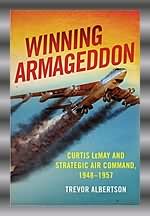 Curtis Lemay
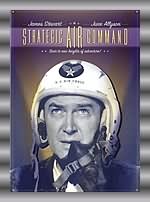 Strategic Air Command